Tampa Bay water, explained: hardness, chlorine, and the seasonal switch
Reviewed by The Baylife Water Filtration Solutions team · Last reviewed · 6 min read
Key takeaways
- Tampa Bay water is genuinely hard — the City of Tampa's own 2025 report puts it at 12.3 grains per gallon.
- Most of our service area's utilities disinfect with chloramine. Hernando County, Brooksville, Plant City, Oldsmar, Dunedin and Tarpon Springs are the exceptions: they run straight chlorine instead, because each draws from its own groundwater wells rather than blending in surface water.
- The blend of groundwater, surface water, and desalinated water that feeds most of the region shifts by season, so your water isn't quite the same in May as it is in October.
Why Tampa Bay water is hard in the first place
Most of our service area sits on top of limestone, and groundwater picks up calcium and magnesium as it moves through it. Add in a blend with surface water from the Hillsborough River and Tampa Bay Water's regional system, and the result is water that measures hard almost everywhere we work.
"Hard" isn't a health term — it's a measurement of dissolved calcium and magnesium, expressed in grains per gallon (gpg). The U.S. Geological Survey calls anything over 7 gpg "hard" and over 10.5 gpg "very hard."
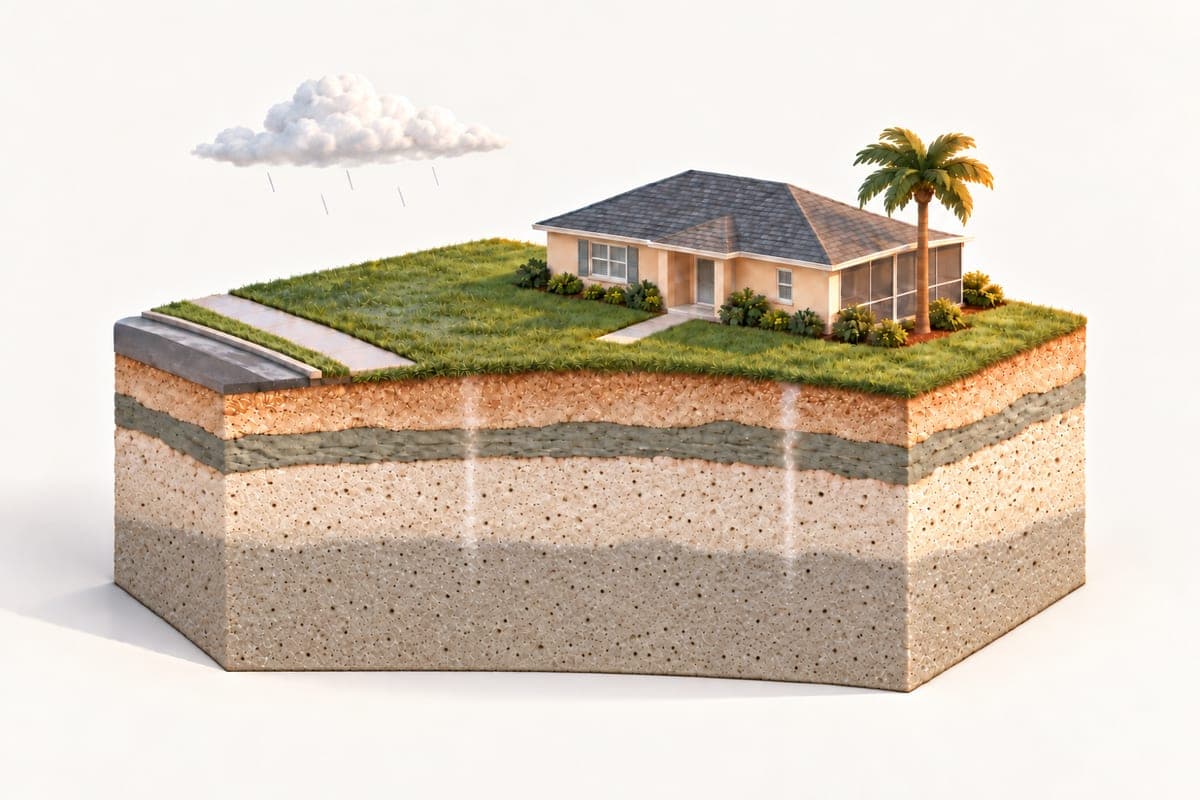
Illustration, not to scale. Most of Tampa Bay sits on limestone. Rain that soaks down into it picks up calcium and magnesium, the minerals that make water hard.
Sources: USGS HA 730-G (opens in a new tab)USGS, Hardness of Water (opens in a new tab)
Hardness by utility
A few utilities publish an exact number in their annual water quality report. Most don't — hardness is an aesthetic measurement, not a regulated one, so Florida doesn't require it in a Consumer Confidence Report (CCR). Where we don't have a published number, we say so and measure it for real at your free in-home test.
- City of Tampa: 12.3 gpg / 211 mg/L (City of Tampa, 2025 water quality report)
- Pinellas County Utilities: 10.2–14.0 gpg (Pinellas County, 2021 CCR)
- St. Petersburg: about 9.2 gpg / 158 mg/L (City of St. Petersburg, 2025–26 water quality report)
- Hillsborough County, Pasco County, Hernando County, and Brooksville: not published — estimated at your free test
Chlorine vs. chloramine
Chlorine and chloramine are both EPA-compliant disinfectants used to keep water safe as it travels through pipes. Chloramine (chlorine plus ammonia) holds its disinfecting power longer over long distances, which is why most of our region's utilities use it as their everyday disinfectant.
Hernando County (HCUD), the City of Brooksville, and the cities of Plant City, Oldsmar, Dunedin and Tarpon Springs are exceptions: each draws its water from its own groundwater wells, with no surface-water blend, and disinfects with straight chlorine year-round — never chloramine.
Neither disinfectant is a safety concern at the levels utilities report. This is a taste-and-filtration distinction, not a health one.
Why the mix changes with the season
Tampa Bay Water, the regional wholesaler for Hillsborough, Pasco, and Pinellas counties plus the cities of Tampa, St. Petersburg, and New Port Richey, blends groundwater, surface water, and desalinated water — and that blend shifts through the year (Tampa Bay Water, "About" page). That's a real reason your water can taste or feel a little different from one month to the next, even with no change at your tap.
What this means for your filtration choice
If hardness is your main complaint — spots, scale, soap that won't rinse clean — start with our softener vs. conditioner guide. If it's taste or smell from chloramine or chlorine, our chloramine-and-chlorine-switches guide covers what handles each.
Sources
- City of Tampa 2025 Water Quality Report (opens in a new tab)
- Pinellas County 2021 CCR (opens in a new tab)
- St. Petersburg 2025–26 Water Quality Report (opens in a new tab)
- Hernando County West Hernando System 2023 CCR (opens in a new tab)
- Hernando County East Hernando System 2024 CCR (opens in a new tab)
- City of Brooksville 2023 CCR (opens in a new tab)
- Tampa Bay Water — About (opens in a new tab)
- USGS Ground Water Atlas of the United States, HA 730-G: Floridan aquifer system (opens in a new tab)
- USGS Water Science School: Hardness of Water (opens in a new tab)